Concrete Tips
Should You Add Fiber to Concrete? What Central Texas Homeowners Need to Know
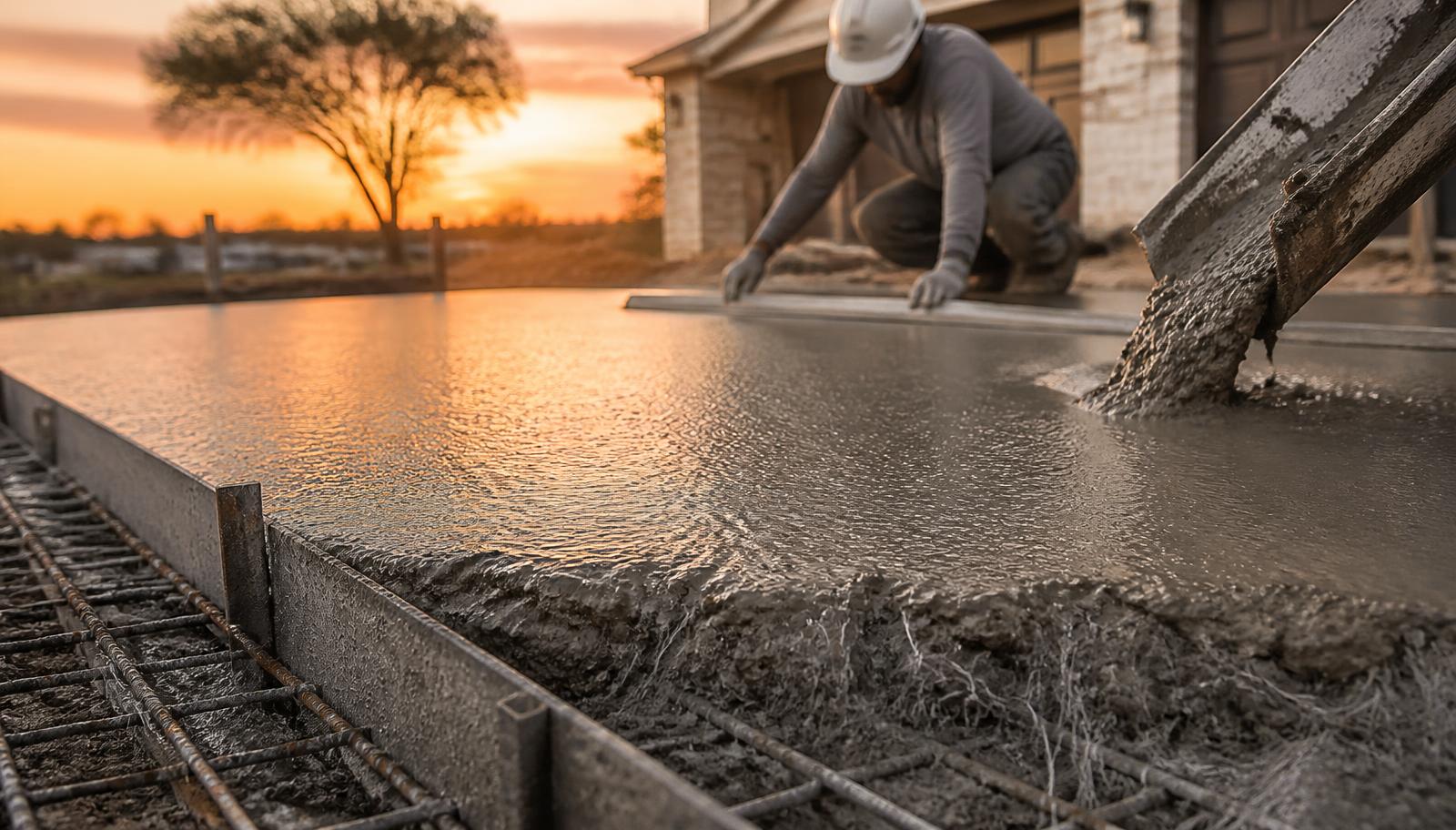
If you've received an estimate for a new driveway, patio, slab, or other concrete project, you may have heard the term fiber-reinforced concrete.
But what exactly is fiber? Is it worth adding? And does adding fiber mean you don't need traditional reinforcement?
At Firm Foundations Concrete, we believe homeowners should understand what's going into their concrete—and why.
What Is Fiber-Reinforced Concrete?
Fiber-reinforced concrete is concrete that contains small fibers distributed throughout the concrete mix.
Depending on the application, contractors may use different types of fibers, including synthetic microfibers, macro-synthetic fibers, glass fibers, or steel fibers.
Instead of reinforcement being located only in specific areas of the slab, fibers are dispersed throughout the concrete mixture.
Why Add Fiber to Concrete?
One of the biggest reasons fiber is added to concrete is crack control.
Concrete naturally shrinks as it cures. Temperature changes, moisture loss, soil movement, loading, and other conditions can also contribute to cracking over the life of a slab.
Certain fibers—particularly microfibers—can help reduce plastic shrinkage cracking, which can occur while fresh concrete is still setting.
Other fiber systems may provide additional reinforcement and improve properties such as toughness and resistance to impact or crack propagation.
Fiber Does NOT Mean Your Concrete Will Never Crack
This is important.
There is no honest concrete contractor who should promise you that concrete will never crack.
There's an old saying in the industry: there are two kinds of concrete—concrete that has cracked and concrete that hasn't cracked yet.
The goal of a properly designed and installed concrete project is to manage and minimize cracking, not pretend cracking can be eliminated entirely.
That involves much more than simply adding fiber.
Proper site preparation, compaction, concrete mix, reinforcement, placement, finishing, curing practices, control joints and drainage can all affect the performance of the finished project.
Does Fiber Replace Rebar?
Not automatically.
Fiber and traditional reinforcement do different jobs, and whether fiber can replace some or all conventional reinforcement depends on the type of fiber, dosage, slab design, loads, engineering requirements and local building requirements.
For many residential projects, fiber may be used in addition to reinforcement such as rebar.
For engineered foundations, commercial projects, heavily loaded slabs and other structural applications, reinforcement should follow the project's plans and engineering specifications.
If someone tells you, 'It has fiber, so it doesn't need rebar,' ask more questions.
Is Fiber Worth Adding to a Driveway?
It can be an excellent addition.
Driveways deal with vehicle traffic, Texas temperature swings, intense summer heat and changing ground conditions.
Fiber can be one part of a well-designed driveway system—but it shouldn't be used as a shortcut for the things that matter underneath the concrete.
A great concrete mix poured over poorly prepared ground is still sitting on poorly prepared ground.
What happens before the concrete truck arrives matters.
Fiber Is Only One Piece of a Quality Concrete Job
When comparing concrete bids, don't make your decision based on one specification alone.
Ask questions such as:
How thick will the concrete be?
What PSI concrete is being used?
How will the subgrade be prepared and compacted?
What reinforcement is included?
Are fibers being added, and what type?
Where will control joints be placed?
How will drainage be handled?
Those details can tell you much more about the quality of a proposed project than price alone.
Building Concrete for Central Texas
At Firm Foundations Concrete, we install concrete throughout Central Texas with a focus on proper preparation, quality materials and workmanship designed for the individual project.
From driveways and patios to slabs, foundations and commercial concrete, we believe our customers deserve to understand exactly what they're paying for.
Considering a concrete project in Belton, Temple, Killeen, Harker Heights, Salado or the surrounding Central Texas area?
Contact Firm Foundations Concrete to discuss your project and get an estimate.
Get a free estimateFAQ
Frequently Asked Questions
- What is fiber-reinforced concrete?
- Fiber-reinforced concrete contains small fibers—synthetic, glass, or steel—mixed throughout the concrete. They help control cracking and can improve toughness, but they do not replace traditional reinforcement in every application.
- Does fiber prevent concrete from cracking?
- No. Fiber helps reduce and control certain types of cracking, especially early plastic shrinkage cracks, but all concrete can crack. Proper prep, reinforcement, joints, and curing are what manage cracking over time.
- Can fiber replace rebar in a driveway or slab?
- Not automatically. Fiber and rebar do different jobs. For many residential projects, fiber is used in addition to rebar. Engineered, commercial, or heavily loaded slabs should follow engineering specifications.
- Is fiber worth adding to a concrete driveway in Central Texas?
- It can be. Central Texas driveways face heat, clay soils, and vehicle loading. Fiber is a useful part of a well-designed system that also includes proper base prep, thickness, rebar, joints, and curing.
- What should I ask a contractor about fiber in concrete?
- Ask what type of fiber is being used, the dosage, whether rebar or mesh is also included, the slab thickness and PSI, how the base will be prepared, and where control joints will be placed.